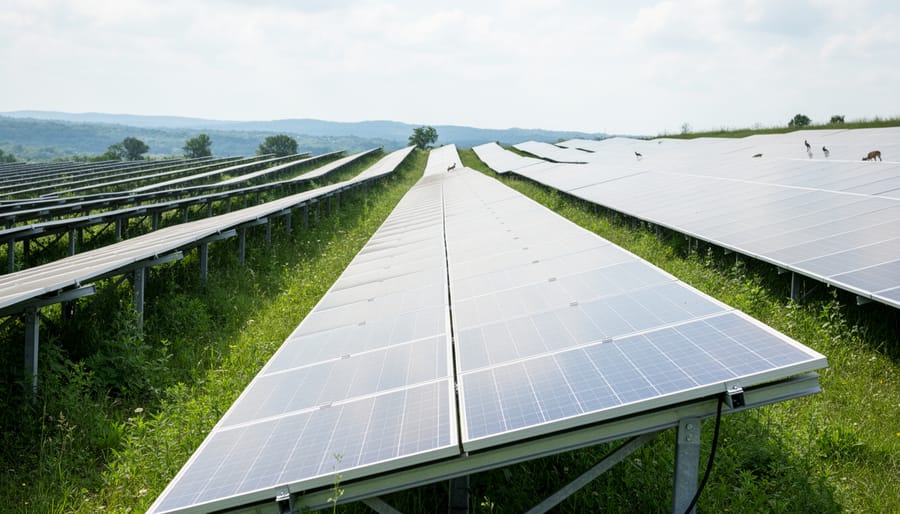
Solar farms do harm the environment in specific, measurable ways, but the scale and nature of these impacts differ dramatically from the ongoing damage caused by fossil fuel extraction and combustion. A solar farm is a large-scale installation of photovoltaic panels or concentrated solar power systems designed to generate electricity for the grid, typically occupying anywhere from a few acres to several thousand acres of land. These facilities represent one of the fastest-growing renewable energy sources globally, but their expansion has raised legitimate questions about habitat loss, water use, soil disruption, and the visual transformation of landscapes.
Understanding whether solar farms harm the environment requires examining the full picture. Yes, constructing a solar installation displaces native vegetation, alters local ecosystems, and requires mining raw materials like silicon, silver, and rare earth elements. Wildlife corridors can be fragmented, desert tortoise habitats disrupted, and agricultural land converted to energy production. The manufacturing process generates carbon emissions, and end-of-life panel disposal presents waste management challenges that the industry is still addressing in 2026.
But context matters enormously. Every energy source carries environmental costs. The relevant question is not whether solar farms have zero impact, which no human infrastructure does, but how their lifetime environmental footprint compares to alternatives and whether mitigation strategies can minimize harm. Research consistently shows that solar installations offset their manufacturing emissions within one to four years of operation, then provide decades of virtually carbon-free electricity. Many documented harms can be substantially reduced through thoughtful site selection, ecological design principles, and emerging best practices in solar farm management.
This article examines both the documented environmental impacts of solar farms and the practical solutions that developers, regulators, and communities are implementing to address them.
What Solar Farms Are and Why They Matter
A solar farm is a large ground-based installation of photovoltaic panels designed to generate electricity at utility scale, meaning it produces enough power to supply hundreds or thousands of homes rather than a single building. These facilities range from a few acres to thousands, depending on their capacity, and they feed electricity directly into the regional power grid.
- Solar Farm
- A large-scale ground-mounted installation of photovoltaic panels designed to generate electricity for the utility grid rather than for individual buildings.
- Utility-Scale Solar
- Electricity generation projects typically rated at 1 megawatt or larger, producing power for distribution through the electric grid to serve communities rather than individual consumers.
- Photovoltaic Array
- The complete assembly of solar panels, mounting structures, and electrical connections that convert sunlight into usable electricity through the photovoltaic effect.
- Land Footprint
- The total ground area occupied by a solar installation, including panels, access roads, inverters, and buffer zones, typically requiring 5-10 acres per megawatt of capacity.
Solar farms matter because they represent one of the fastest-growing sources of renewable electricity worldwide. As nations work to reduce greenhouse gas emissions and transition away from fossil fuels, utility-scale solar has become a cornerstone technology capable of replacing coal and natural gas power plants. Understanding their environmental impacts is crucial for sustainable energy planning because decisions made today about where and how to build solar farms will shape landscapes for decades. The question isn’t whether we should deploy solar energy, but how to do it in ways that maximize climate benefits while minimizing harm to ecosystems, agricultural land, and local communities.
How Solar Farms Work and Interact with Their Environment
Energy Conversion and Land Coverage
Solar panels work through the photovoltaic effect: semiconducting materials inside each cell absorb photons from sunlight and release electrons, creating a direct current that inverters convert into alternating current for the grid. If you want more detail on how solar works the basics remain simple, panels capture light, semiconductors generate charge, and electrical components deliver power.
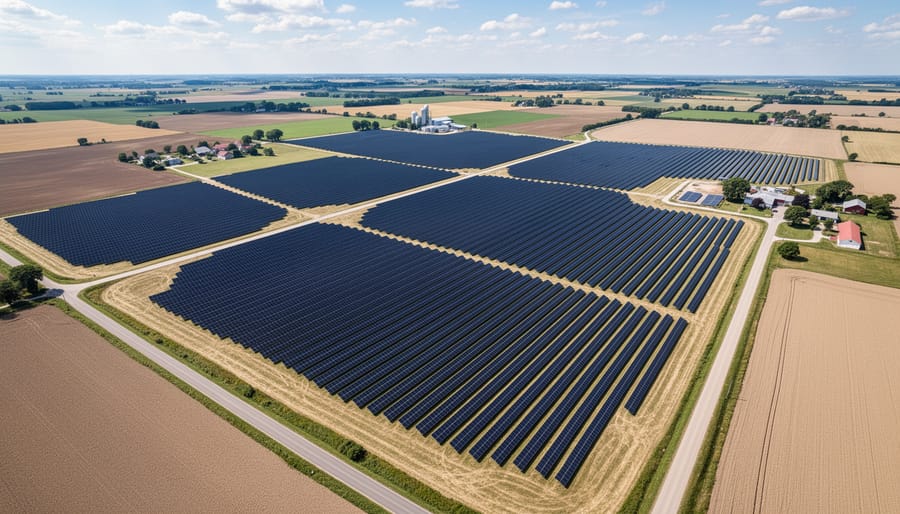
The catch is efficiency and scale. Commercial photovoltaic panels typically convert 15 to 22 percent of incoming sunlight into electricity, which means large surface areas are necessary to produce utility-scale power. A 100-megawatt solar farm, enough to supply roughly 20,000 homes, usually requires 500 to 800 acres depending on panel efficiency, local solar irradiance, and site layout. Solar land footprint estimates vary by region, but five to seven acres per megawatt is a typical benchmark globally.
This land requirement sets the stage for environmental trade-offs. Unlike rooftop installations that use existing structures, ground-mounted solar farms occupy greenfield sites, farmland, or natural habitats. The sheer physical footprint drives nearly every environmental concern discussed in this article.
Ecosystem Interactions During Operation
Once panels start generating electricity, they create a new physical environment beneath and around them. The most immediate change is shade: arrays block between 30% and 80% of direct sunlight depending on panel density and tracking systems, lowering ground temperatures by several degrees and reducing evaporation rates. This cooler, shadier microclimate can benefit certain plant species while inhibiting sun-loving native vegetation, shifting the composition of ground cover over time.
Water behavior changes substantially. Panels concentrate rainfall into drip zones along their edges rather than distributing it evenly across the landscape, creating alternating wet and dry strips that affect where plants establish and how soil erodes. Research on stormwater and soil effects shows that without proper controls, runoff velocity increases and erosion can occur in these concentrated flow paths, though vegetation management and drainage design effectively address this.
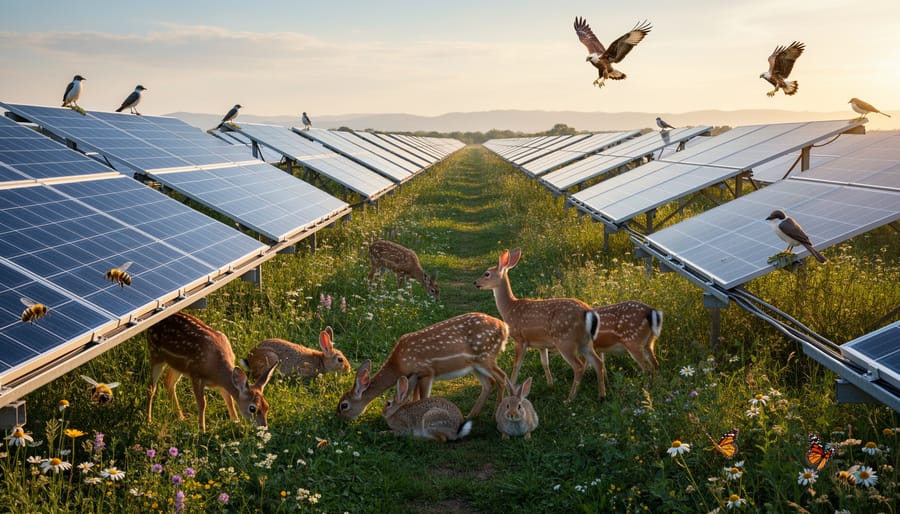
Wildlife responds to these altered conditions in varied ways. Some species avoid the new structures entirely, viewing them as barriers that fragment habitat and disrupt traditional movement corridors. Others adapt quickly, small mammals and ground-nesting birds sometimes find shelter beneath panels, while predators learn to hunt along the shade-to-sun transitions where prey congregate.
Environmental Benefits: How Solar Farms Help the Planet
Solar farms deliver measurable environmental benefits that extend far beyond their visible footprint. The most significant advantage lies in displacing fossil fuel electricity generation, which directly translates to reduced greenhouse gas emissions. For every megawatt-hour produced by utility-scale solar, approximately 0.4 to 0.9 metric tons of CO₂ are avoided compared to coal-fired generation, and 0.3 to 0.5 metric tons compared to natural gas plants. At scale, this matters enormously: a 100-megawatt solar farm can prevent roughly 80,000 to 120,000 metric tons of carbon dioxide from entering the atmosphere annually, equivalent to removing 17,000 to 26,000 cars from roads for a year.
Air quality improvements represent another substantial benefit often overlooked in environmental discussions. Unlike combustion-based power plants, operating solar farms produce zero nitrogen oxides, sulfur dioxide, or particulate matter, pollutants with direct links between energy and air pollution that cause respiratory illnesses and premature deaths. Research tracking regions with high solar adoption shows measurable reductions in smog formation and respiratory hospital admissions during peak generation hours when solar displaces fossil fuel plants.
Water conservation constitutes a third critical advantage. Conventional thermal power plants, whether coal, natural gas, or nuclear, require enormous volumes of water for cooling towers and steam generation, typically 300-600 gallons per megawatt-hour produced. Solar photovoltaic systems need virtually no water during operation beyond occasional panel cleaning, which uses roughly 10 gallons per MWh even in dusty climates. A single large solar farm can save 100 million gallons of freshwater annually compared to an equivalent coal plant, a particularly valuable benefit in water-stressed regions.
When evaluating complete lifecycle emissions comparison including manufacturing, transportation, installation, and decommissioning, solar farms still demonstrate clear advantages. Lifecycle carbon intensity for utility-scale solar ranges from 30-50 grams CO₂-equivalent per kilowatt-hour, compared to 820-1,100 g/kWh for coal and 450-650 g/kWh for natural gas. The energy required to manufacture panels is typically recovered within one to three years of operation, after which the remaining 20-30 year operational lifespan represents net environmental gain.
Potential Environmental Harms and Challenges
Land Use and Habitat Disruption
Solar farms require considerable space, typically 5 to 10 acres per megawatt of capacity, which means a single large installation can occupy several thousand acres. When developers select sites poorly, this footprint directly displaces natural ecosystems. Grasslands, scrublands, and desert habitats face particular pressure because their flat, sunny characteristics make them attractive for solar development, yet these same ecosystems often support species already stressed by climate change and urban expansion.
Agricultural land conversion presents another layer of concern. Productive farmland sometimes gives way to solar arrays, especially in regions where electricity prices make solar development more lucrative than crop production. While this shift doesn’t necessarily harm the environment in the same way as paving over wilderness, it raises questions about food security and the permanent alteration of working landscapes.
The primary land-use concerns include:
- Space requirements of 5-10 acres per megawatt for utility-scale installations
- Displacement of grassland, desert scrub, and prairie habitats that support specialized species
- Conversion of agricultural land from food production to energy generation
- Soil compaction from heavy equipment during construction, reducing long-term ecological recovery potential
Habitat fragmentation compounds these direct impacts. Large solar farms can divide wildlife corridors, preventing animals from accessing water sources, breeding grounds, or seasonal ranges. Desert tortoises in the southwestern United States have lost connectivity between populations due to solar installations blocking historical movement paths. For species with limited mobility or specific territorial needs, even a well-designed solar farm creates barriers that didn’t exist before.
Site selection makes an enormous difference. Developers who prioritize degraded land, abandoned industrial sites, contaminated brownfields, or heavily grazed areas with low biodiversity, minimize ecological harm. Those who choose intact ecosystems purely for cost or grid proximity reasons inflict damage that mitigation efforts struggle to undo.
Effects on Wildlife and Ecosystems
Solar farms affect wildlife in ways that vary considerably by location and design. Bird populations face multiple challenges: raptors and waterfowl sometimes mistake reflective panels for water bodies, the so-called “lake effect” or “polarotactic trap”, leading to dangerous landing attempts on hard surfaces. While collision mortality rates are lower than those from windows or wind turbines, concentrated solar installations with heat towers pose higher risks than photovoltaic arrays. Studies from California’s Mojave Desert document injuries to birds attempting to land on panel fields.
Ground-dwelling species experience habitat fragmentation and movement barriers. The desert tortoise, a threatened species in the American Southwest, loses crucial foraging territory when panels cover native scrubland. Fencing around installations blocks migration routes for pronghorn antelope and other wide-ranging animals, isolating populations.
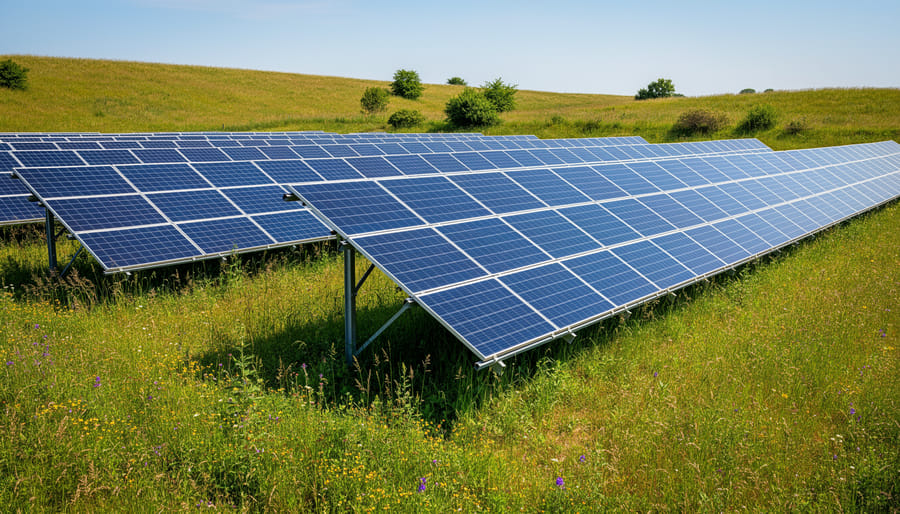
Not all impacts are negative. When designed thoughtfully, solar farms can support pollinators. Native wildflower plantings beneath panels provide forage for bees and butterflies, and the shade creates microclimates that retain soil moisture, benefiting insect populations in arid regions. British solar farms with meadow vegetation have shown increased pollinator diversity compared to intensive agricultural fields. The ecological outcome depends largely on what the solar farm replaces and how the site is managed during operation.
Water Use and Soil Considerations
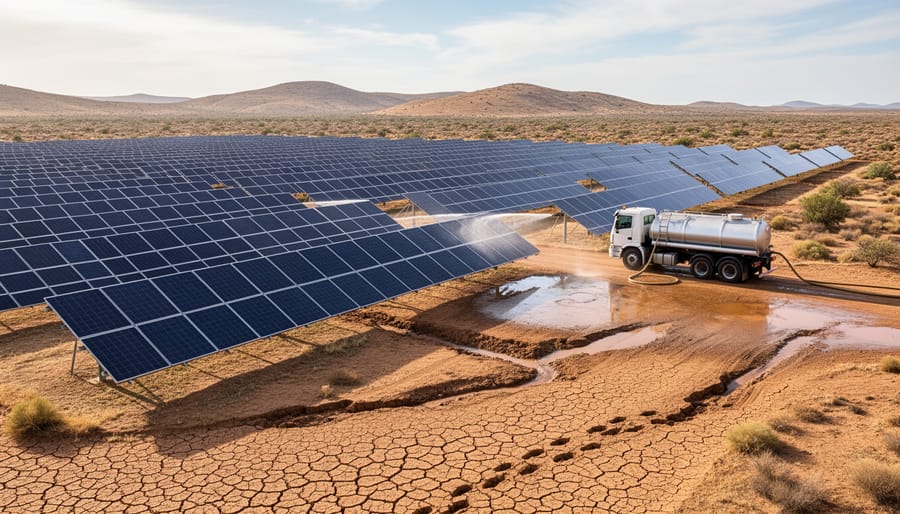
Water concerns surrounding solar farms vary significantly by location and design. In arid regions where dust accumulation reduces panel efficiency, operators may clean arrays several times per year using water trucks or automated systems. A typical utility-scale installation might consume 20-30 gallons per megawatt annually for cleaning, modest compared to thermoelectric power plants, which withdraw thousands of gallons per MWh for cooling, but still meaningful in water-scarce areas. Some facilities have adopted waterless robotic cleaning or dry brushing systems to eliminate this demand entirely.
Construction phases present temporary but concentrated water use for dust suppression, concrete mixing for foundations, and soil compaction. These activities can alter natural drainage patterns, potentially accelerating erosion or creating localized flooding if stormwater management isn’t carefully planned.
Soil impacts depend heavily on installation methods. Ground-mounted systems with driven piles cause minimal disturbance, while those requiring extensive grading, trenching for cables, or concrete pads can compact soil, reducing permeability and disrupting biological activity. Concentrated runoff beneath panel rows may cause channeling and nutrient loss over time. However, keeping vegetation beneath arrays, rather than using gravel beds, helps maintain soil health, prevents erosion, and supports moisture retention.
Visual Impact and Local Environmental Quality
Large-scale solar installations fundamentally alter landscapes, particularly in rural or previously undeveloped areas. Arrays of dark panels stretching across hillsides or desert valleys create industrial corridors in settings once characterized by open space or agricultural fields. This visual transformation raises legitimate concerns in communities that value scenic vistas or landscapes with minimal human infrastructure.
Glare from reflective panels can affect nearby residents, motorists on adjacent roads, and even aircraft in certain installations near airports. While modern anti-reflective coatings have reduced this issue substantially compared to earlier designs, low-angle sunlight still produces occasional reflections that neighbors find disruptive.
Heat island effects represent another local environmental quality concern. Dark panel surfaces absorb significant solar radiation, elevating temperatures above the array compared to natural vegetation or bare ground. Studies document temperature increases of 3-4°C over large installations, potentially affecting local microclimates and contributing to warmer nighttime temperatures in surrounding areas.
Manufacturing and End-of-Life Concerns
Solar panel manufacturing carries a significant environmental footprint before the first kilowatt-hour is ever generated. The production process requires substantial energy, often from fossil fuel sources in manufacturing hubs, and involves mining silicon, silver, and materials like tellurium or indium for certain panel types. Extracting these raw materials can lead to habitat disruption, water pollution, and carbon emissions, particularly when sourcing occurs in regions with lax environmental standards.
The manufacturing phase also generates hazardous byproducts. Silicon processing produces silicon tetrachloride, a toxic substance requiring careful disposal. Thin-film panels may contain cadmium or lead, raising concerns about worker safety and environmental contamination during production.
End-of-life disposal presents another challenge. Solar panels typically last 25 to 30 years, and the first wave of large-scale retirements is approaching. While panels contain recoverable materials like glass, aluminum, and silicon, recycling infrastructure remains underdeveloped in many countries. Without proper recycling programs, decommissioned panels risk ending up in landfills, where encapsulated metals could potentially leach into soil and groundwater over decades.
The industry is responding with improved recycling technologies and circular economy initiatives. European regulations now mandate panel take-back schemes, and companies are developing processes to recover over 95 percent of panel materials. These efforts reduce the manufacturing-to-disposal environmental burden considerably.
Different Types of Solar Farm Designs and Their Environmental Footprints
Not all solar farms are built the same. Design choices significantly influence a project’s environmental footprint, from how much land it needs to whether wildlife can coexist beneath the panels.
Fixed-tilt arrays represent the simplest configuration. Panels sit at a predetermined angle year-round, typically optimized for the site’s latitude. These systems require minimal maintenance and have no moving parts, but they occupy more ground area per megawatt than tracking systems because panels must be spaced farther apart to prevent shading. The static design means vegetation beneath can receive consistent partial shade patterns, which benefits some plant species but creates uniform conditions across large areas.
Single-axis trackers rotate panels from east to west throughout the day, following the sun’s path and boosting energy generation by 15-25% compared to fixed systems. This efficiency gain means less land is needed per unit of electricity produced. However, the motor drives and mechanical components require more materials during manufacturing and create additional maintenance needs. The moving shadows create more variable light conditions for ground vegetation.
Dual-axis trackers add north-south movement for maximum sun alignment, increasing output another 5-10% over single-axis systems. While they deliver the highest energy density, they’re mechanically complex and expensive, making them rare at utility scale. The superior efficiency can justify smaller project footprints in land-constrained areas.
Elevated mounting raises panels 2-3 meters above ground rather than the standard meter or less. This design allows continued agricultural use or native vegetation restoration underneath. Sheep grazing operations particularly benefit from elevated arrays, as do ground-nesting birds and small mammals that can move freely in the shaded zone below.
Agrivoltaic systems deliberately combine energy generation with crop production or grazing. Panels are spaced wider and mounted higher, allowing tractors to pass and crops to receive adequate sunlight. Research shows certain crops, especially leafy greens and shade-tolerant vegetables, actually thrive in the partial shade, requiring less irrigation in hot climates. Some projects incorporate integrated photovoltaics into greenhouse structures or vertical farming systems. While agrivoltaics use land more efficiently than separate solar and agricultural plots, they generate roughly 10-20% less electricity per hectare than conventional dense arrays, creating an economic trade-off developers must consider against the dual-use environmental benefits.
Mitigation Strategies: Making Solar Farms More Environmentally Friendly
The environmental challenges solar farms present aren’t insurmountable, developers, researchers, and policymakers worldwide have identified practical strategies that substantially reduce negative impacts while preserving energy generation capacity. These mitigation approaches span site selection, design modifications, operational practices, and end-of-life planning.
Smart siting represents the first line of defense. Locating solar farms on already-degraded land, former industrial sites, contaminated brownfields, abandoned agricultural areas, or alongside highways and railways, avoids disturbing intact ecosystems while putting underutilized space to productive use. Geographic information systems now help planners identify locations with high solar potential but low biodiversity value, steering projects away from critical habitats, migration corridors, and areas supporting threatened species.
Design innovations address many operational impacts. Agrivoltaic systems, which integrate agriculture with solar generation, allow continued food production or grazing beneath elevated panel arrays. Sheep grazing has become particularly popular in Europe and increasingly in North America, providing vegetation management that reduces mowing needs while supporting local farming. Spacing panels to allow sunlight penetration and planting native vegetation creates pollinator habitat, some solar farms now support greater bee and butterfly populations than surrounding monoculture farmland. This approach transforms what could be biological deserts into functional ecosystems.
Proven mitigation measures implemented during planning and construction include:
- Native vegetation seeding beneath and around panels to support local pollinators and prevent erosion
- Elevated panel mounting systems that maintain grazing space and wildlife movement
- Pre-construction biodiversity surveys to identify and protect sensitive species
- Seasonal construction timing that avoids breeding periods for ground-nesting birds and reptiles
- Water-efficient panel cleaning methods including dry brushing and minimal-water techniques
Wildlife-friendly fencing allows smaller animals to pass through while protecting solar system components and designated corridors maintain connectivity between habitat patches. Advanced monitoring helps operators detect and respond to unexpected wildlife impacts, from modifying panel spacing to installing bird-safe markers where collision risks emerge.
Addressing manufacturing and disposal concerns requires industry-wide change. Manufacturers are reducing toxic materials in production, increasing recycled content in panels and frames, and designing for easier disassembly. Extended producer responsibility programs in Europe now require manufacturers to fund end-of-life recycling, creating economic incentives for recoverable designs. These upstream and downstream interventions tackle impacts beyond the farm site itself, improving solar energy’s full lifecycle footprint.
Comparative Context: Solar Farms vs. Other Energy Sources
To properly evaluate solar farms’ environmental impact, we must compare them against the alternatives. Every energy source carries ecological costs, the question is one of relative scale.
Greenhouse Gas Emissions
Solar farms produce approximately 40-50 grams of CO2 equivalent per kilowatt-hour over their lifecycle, accounting for manufacturing, installation, and disposal. Coal plants emit 820-1,100 grams per kWh, roughly twenty times more. Natural gas generates 450-500 grams, still ten times solar’s footprint. Nuclear power matches solar at 40-60 grams, while wind edges slightly lower at 10-15 grams. Hydroelectric varies widely (20-200 grams) depending on reservoir methane emissions.
Land Use Intensity
Solar farms require 2-4 hectares per megawatt of installed capacity. This seems substantial until compared across actual energy production. Per gigawatt-hour annually, solar uses about 15-20 hectares. Coal mining and power generation combined demand 25-30 hectares when extraction areas are included. Hydroelectric dams flood 50-400 hectares per GWh depending on reservoir size. Wind farms occupy larger total areas but leave 95% available for agriculture or grazing.
Water Consumption
Here solar excels dramatically. Panel cleaning requires less than 30 liters per megawatt-hour, mostly in desert installations. Coal thermoelectric plants consume 1,500-2,000 liters per MWh for cooling. Natural gas uses 800-1,200 liters. Nuclear power demands 1,500-2,500 liters. Only wind rivals solar’s minimal water footprint.
Ecosystem Disruption Patterns
Solar farms fragment habitats but typically avoid wetlands and prime forests. Coal mining devastates landscapes through mountaintop removal and acid drainage lasting decades. Hydroelectric dams permanently submerge ecosystems and block fish migration. Nuclear facilities create thermal pollution in cooling waterways. Wind turbines pose collision risks to birds and bats but permit ground-level habitat continuation.
The data consistently shows solar’s environmental impacts, while real, remain substantially lower than fossil fuel alternatives across nearly every metric.
Regional Variations and Global Perspectives
Environmental impacts from solar farms vary dramatically based on geography, climate, and land-use context. In desert regions like the southwestern United States and parts of Australia, solar installations may disrupt fragile ecosystems adapted to extreme conditions, affecting species like the desert tortoise that require decades to establish populations. However, these arid zones offer abundant sunlight and often feature degraded or low-biodiversity land suitable for development with minimal ecological disruption.
European countries typically build solar farms on previously disturbed sites, former industrial land, brownfields, or low-productivity agricultural areas, reducing habitat loss. Germany and the Netherlands have pioneered agrivoltaic systems that maintain dual land use, combining sheep grazing or pollinator meadows beneath panels. This approach maximizes land efficiency while supporting biodiversity, contrasting sharply with large-scale monoculture solar installations that eliminate existing ecosystems entirely.
Grassland and prairie conversions in North America raise particular concerns because these ecosystems sequester significant carbon in their root systems and support specialized pollinators and ground-nesting birds. Converting native grassland produces greater environmental harm than siting panels on already-degraded farmland or industrial zones.
Asian countries face unique challenges. India’s rapid solar expansion must balance energy efficiency goals with intense agricultural land pressure, leading to creative solutions like canal-top installations that reduce water evaporation while generating power. China’s massive desert solar farms in Inner Mongolia minimize habitat disruption but face dust accumulation and extreme temperature challenges.
Australia’s approach emphasizes remote installations on pastoral lease land, often integrating continued livestock grazing. This dual-use model maintains rural livelihoods while expanding renewable capacity, demonstrating that geographic and cultural context fundamentally shapes both the environmental footprint and the social acceptance of utility-scale solar development.
Common Questions About Solar Farms and the Environment
The environmental impact of solar farms raises practical questions for landowners, community members, and those concerned about sustainable energy development. These common queries address specific concerns based on documented research and real-world experience.
Do solar farms kill large numbers of birds?
Solar farms cause far fewer bird deaths than fossil fuel plants, windows, or domestic cats. Some bird mortality occurs from the “lake effect” where panels are mistaken for water, but proper siting away from migration routes and design modifications significantly reduce these incidents.
Can farming continue underneath solar panels?
Yes, through agrivoltaic systems that combine solar generation with agriculture. Sheep grazing is common beneath elevated panels, and certain crops actually benefit from partial shade, creating dual land use that addresses food-energy competition concerns.
Are solar panels themselves toxic or hazardous?
Modern crystalline silicon panels contain minimal toxic materials during operation. The main concern involves cadmium or lead in some thin-film panels and proper handling during manufacturing and end-of-life disposal, which recycling programs increasingly address.
Do solar farms create heat islands that affect local climate?
Large arrays can create modest localized warming, typically 3-4°C above ground level. This effect is generally confined to the immediate area and far less significant than urban heat islands from pavement and buildings.
What happens to solar panels when they reach the end of their lifespan?
Panel lifespans average 25-30 years, after which they can be recycled to recover silicon, glass, aluminum, and copper. Recycling infrastructure is expanding globally, though current recovery rates vary by region and more development is needed.
Can native plants and wildflowers grow at solar farm sites?
Absolutely. Many operators now plant native vegetation and pollinator-friendly wildflowers beneath and around panels, creating habitat that can support greater biodiversity than intensive agriculture or degraded land previously did.
These questions reflect genuine environmental considerations rather than obstacles to solar development. The answers point toward practical solutions already being implemented, demonstrating that concerns about solar farms can be addressed through thoughtful design, responsible siting, and ongoing improvement in technology and practices. Understanding these specifics helps communities make informed decisions about proposed solar projects in their areas.
Solar farms do harm the environment, but not in the way the question often implies. The real issue isn’t whether impacts exist, they clearly do, but whether those impacts are acceptable given the alternative. Land conversion, habitat disruption, and manufacturing footprints are genuine environmental costs that require honest acknowledgment and active mitigation.
What the science consistently shows is that these trade-offs pale against the ongoing devastation from fossil fuel extraction and combustion. A solar farm occupies land for decades, but a coal plant poisons air, water, and soil while accelerating the climate crisis that threatens ecosystems globally. The comparison isn’t close. Solar installations generate electricity with roughly 95% fewer lifecycle emissions than coal and avoid the water contamination, mountaintop removal, and particulate pollution inherent to conventional generation.
The question we should be asking isn’t whether solar farms have zero environmental impact, nothing does, but whether we’re deploying them intelligently. Siting installations on degraded agricultural land rather than pristine desert, incorporating pollinator habitat beneath panels, maintaining wildlife corridors, and advancing recycling infrastructure all demonstrate that impacts are manageable through thoughtful design.
Energy transitions involve choices, not perfection. Solar farms represent a necessary compromise: accepting localized, reversible land use changes to prevent irreversible global climate damage. The environmental conversation shouldn’t center on whether solar is flawless, but on how to deploy it responsibly as part of a diversified renewable strategy. Understanding both the benefits and harms allows for informed advocacy toward better outcomes.